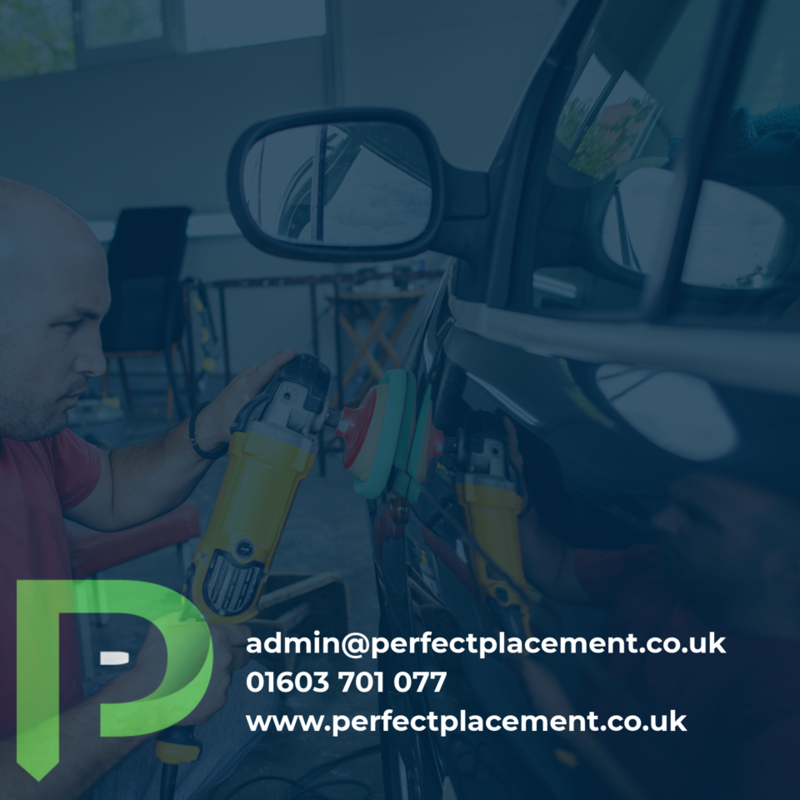
A Bodyshop Prepper prepares repaired or replacement vehicle panels so they are ready for paint. Sanding, flatting, filling, masking and priming all sit at the heart of the job. The work may happen before a Paint Sprayer applies the final finish, but the quality of that finish depends heavily on the preparation underneath.
This practical motor trade role can suit someone who enjoys hands-on work, has a good eye for surface defects and takes pride in getting the detail right. You need to work carefully, but also keep pace with a busy bodyshop repair plan and communicate well with the people completing the next stage of the job.
At Perfect Placement, we work with Bodyshop Prepper candidates and Automotive employers across the UK, so we see first-hand what businesses look for and what candidates can realistically expect from the market.
In short
A Bodyshop Prepper gets panels and vehicles ready for refinishing by sanding, filling, priming, masking and checking surfaces. The role suits practical, detail-focused candidates who can balance finish quality with bodyshop deadlines. Experienced Preppers can build solid earning potential and may progress into paint spraying, senior preparation, quality control or wider bodyshop roles.
Key Takeaways
- Most Bodyshop Prepper jobs are found in accident repair centres, independent bodyshops, dealership bodyshops and vehicle refurbishment operations.
- Based on Bodyshop Prepper vacancies advertised through Perfect Placement during 2025 and into 2026, the average basic salary was £37,196, with an average OTE of £38,619.
- Employers usually value proven sanding, filling, priming and masking ability, along with speed, consistency and safe working practices.
- Progression can lead to Senior Prepper, Paint Sprayer, multiskilled Bodyshop Technician, Quality Controller or workshop supervision roles.
What Does a Bodyshop Prepper Do?
A Bodyshop Prepper creates the smooth, clean and correctly keyed surface needed before paint is applied. You may work on a small local repair, a replacement panel or several repaired areas across a vehicle. The job starts with understanding what has been repaired and finishes with a careful check before the vehicle passes to the paint stage.
In a larger Accident Repair Centre, preparation and spraying may be separate jobs. In a smaller independent bodyshop, one technician may cover preparation, paint and final polishing. Vacancy titles can therefore include Bodyshop Prepper, Vehicle Prepper, Paint Prepper, Prep Technician or Prepper and Polisher. Always read the duties rather than relying on the title alone.
Typical day-to-day responsibilities
- Reading job cards and checking which panels and repair areas need preparation.
- Sanding and flatting repaired, primed or replacement panels using suitable grades and equipment.
- Applying and shaping body filler to remove minor surface imperfections where the job requires it.
- Applying primer and preparing it correctly for the next refinishing stage.
- Masking panels, trims, glass and surrounding areas to control overspray and protect the vehicle.
- Cleaning and degreasing surfaces to reduce contamination and paint defects.
- Checking edges, contours and repaired areas under suitable lighting before sign-off.
- Moving completed work to the paint team and raising any repair issue that could affect the finish.
- Using extraction, dust control, PPE and refinishing products in line with site safety procedures.
- Keeping the preparation bay, tools and materials organised during a busy repair schedule.
Good preparation is not simply making a panel look smooth from a distance. Missed pinholes, poor feather edging, deep sanding marks, contamination or careless masking can all show through later. That can lead to rework, lost workshop time and a delayed vehicle handover, so experienced Preppers are an important part of repair quality and bodyshop efficiency.
What Skills Do You Need to Be a Bodyshop Prepper?
Employers want a Prepper who can deliver repeatable work at the required standard. Speed matters in a productive bodyshop, but rushing a surface that later needs repainting helps nobody. The strongest candidates know when a panel is ready and when a defect needs to go back to a Panel Beater or be discussed with the Paint Sprayer.
Practical skills employers commonly look for
- Confident sanding, flatting, feather edging, filling, priming and masking skills.
- An eye for ripples, pinholes, scratches, poor edges and other surface imperfections.
- Knowledge of preparation materials, abrasive grades, curing times and safe product use.
- Care when working around trims, seals, glass, sensors and undamaged paintwork.
- Consistent workmanship across local repairs, complete panels and larger repair areas.
- Good time management when several vehicles are moving through the bodyshop.
- Ability to follow job cards, repair instructions and site quality processes.
- Safe use of sanders, extraction systems, infrared curing equipment and PPE.
Personal qualities that help
Patience and concentration are important because small preparation faults can become obvious after paint. You also need to be dependable. Paint teams plan their workload around vehicles arriving ready, so delays or unfinished prep can affect the whole department. Clear communication helps when a repair needs further panel work, a part is missing or the original estimate does not match what you find.
The work is physical and usually involves standing, bending, reaching and wearing PPE for long periods. Candidates who enjoy practical routines, visible results and working as part of a workshop team often settle well into the role.
How to Become a Bodyshop Prepper
There is no single route into bodyshop preparation. Some candidates begin through a vehicle damage paint or body repair apprenticeship. Others start as a bodyshop assistant, valeter, polisher or trainee Prepper and learn under experienced technicians. Related experience in SMART repair, vehicle refurbishment, cosmetic repair or classic vehicle restoration may also be useful if it has included proper surface preparation.
A relevant Level 2 or Level 3 qualification in vehicle accident repair, paint refinishing or vehicle body and paint can strengthen an application. Employers may also value industry accreditation, product training and up-to-date health and safety knowledge. Exact requirements vary, and practical ability is often tested through a trade test or detailed technical interview.
What to show when applying
- The types of vehicles, panels and repair work you have prepared.
- Whether you can fill, prime and mask independently, or which areas still require training.
- Experience in high-volume accident repair, dealership, commercial vehicle or refurbishment settings.
- Any paint-system, manufacturer, EV awareness or health and safety training.
- Your normal productivity expectations and how quality is checked at your current site.
- Whether you also spray, polish or complete SMART repairs.
Previous professional bodyshop experience is usually preferred for experienced vacancies because employers need someone who understands repair flow and finish standards. Trainee opportunities do appear, but candidates should expect to begin with closely supervised preparation tasks and build speed as their work becomes more consistent.
What Is the Working Environment Like?
Bodyshop Preppers usually work in accident repair centres, independent bodyshops, dealer group repair sites, commercial vehicle workshops or vehicle refurbishment operations. You will commonly work with Panel Beaters, Paint Sprayers, MET Technicians, Polishers, Quality Controllers and a Bodyshop or Workshop Controller.
The environment can be noisy, dusty and physically active, although a well-run site will use extraction, separated work areas, suitable lighting and clear safety controls. Preparation work involves paints, primers, fillers, hardeners, solvents and airborne dust, so wearing the required respiratory, eye, hearing, skin and body protection is part of the job rather than an optional extra.
Many roles operate Monday to Friday across roughly 40 to 45 hours, but the detail varies. Some employers offer paid overtime, longer weekdays or occasional Saturdays. Larger repair centres may use productivity or efficiency measures, while smaller sites may expect broader duties such as polishing, small repairs or moving vehicles. The Perfect Placement guide to working for an Accident Repair Centre gives further context on repair flow, team structure and the wider bodyshop environment.
Customer contact is normally limited compared with an estimating or service role, but your work still affects the customer's experience. A preparation fault can delay the repair or become visible in the final finish, so the standards set by the customer, insurer, manufacturer-approved repair process and site quality checks all reach the prep bay.
Bodyshop Prepper Salary and Market Insight
Bodyshop Prepper salaries vary depending on your experience, the employer, location and the type of bodyshop you work in. Candidates who can consistently prepare panels to a high standard and work efficiently are often in the strongest position when negotiating pay.
The figures below are based on Bodyshop Prepper vacancies advertised through Perfect Placement during 2025 and 2026. They provide a snapshot of the current recruitment market rather than a national average.
£37,196
Average basic salary in the supplied vacancy sample
£38,619 OTE
Average advertised earning level
£28k to £52k
Basic salary range in the supplied sample
When comparing Bodyshop Prepper jobs, don't just look at the advertised salary. Check whether the role includes bonus or overtime, what your contracted hours are, and whether training, tools and PPE are provided. A higher OTE isn't always the better offer if the bonus is difficult to achieve or the basic salary is comparatively low.
What can affect your pay?
- Experience and quality: Employers are willing to pay more for Preppers who consistently produce high-quality work with minimal rework.
- Broader skills: Experience with polishing, SMART repairs or paint spraying can open up higher-paying opportunities.
- Location: Salaries tend to be higher in areas where demand for skilled bodyshop staff is strongest, although living costs should also be considered.
- Employer: Accident repair centres, dealership bodyshops, commercial vehicle repairers and independent businesses can all offer different pay structures, bonus schemes and working patterns.
- Hours and bonus structure: Always check how overtime and bonuses are calculated, and whether productivity or quality targets influence your earnings.
When comparing Bodyshop Prepper jobs, check the basic salary, contracted hours, overtime rate, bonus basis, holiday allowance, pension, tools, PPE and training. A higher OTE is not automatically the better offer if the targets are difficult to influence or the base salary is lower.
Career Progression and Opportunities
A Bodyshop Prepper can build a long-term technical career or use the role as a route into a wider range of bodyshop work. Progress normally comes from improving finish quality, becoming productive without cutting corners and learning more of the repair process.
Common progression routes
- Senior Prepper or Lead Prepper: Taking responsibility for more complex work, supporting trainees and helping maintain preparation standards.
- Bodyshop Paint Sprayer: Developing paint mixing, colour matching, blending and spray booth skills. See the Automotive Career Guide: Paint Sprayer for a fuller picture.
- Multiskilled Bodyshop Technician: Combining preparation with spraying, SMART repair, polishing or light panel work.
- Quality Controller: Using a strong eye for finish quality to inspect completed repairs and identify defects before handover.
- Workshop Controller or Bodyshop Supervisor: Moving towards job allocation, workflow, productivity and team support after building wider repair knowledge.
If you want to progress, ask for exposure to paint systems, colour theory, blending, repair methods and quality checking. Keeping evidence of training and being honest about the work you can complete independently will help when you apply for the next level.
How the Role Is Changing
The fundamentals of sanding, filling and masking remain important, but the vehicles and repair processes around them are changing. Modern bodyshops work with more aluminium, composites, plastics, water-based refinishing systems and manufacturer-specific materials. Candidates need to follow the right process rather than assume that every panel and product can be treated in the same way.
EV and hybrid vehicles also bring different safety controls. A Prepper may not disconnect a high-voltage system, but should understand site rules, vehicle status and where drilling, sanding, heat or repair products could create a risk. ADAS sensors and cameras can sit behind bumpers, screens and body panels, so careless masking, contamination or damage around these areas can affect later calibration or vehicle operation.
Digital job cards, workshop management systems and image records are becoming more common. Preppers may need to record progress, flag additional damage and follow manufacturer or insurer repair instructions on screen. Dust extraction, low-energy curing and more efficient material use are also receiving greater attention as bodyshops manage safety, environmental impact and cost.
Common Challenges of the Role
Preparation can be satisfying because the result is visible, but it is demanding work. The main challenge is maintaining a high standard while vehicles are moving against booked completion dates and other technicians are waiting for the next job.
- Time pressure: Workshop loading and handover dates can create pressure to move work quickly.
- Rework risk: A missed defect may only become obvious after paint, when correcting it is more expensive and disruptive.
- Physical demands: Repetitive sanding, standing, bending and PPE can be tiring across a full shift.
- Dust and product exposure: Extraction, housekeeping and correct PPE need consistent attention.
- Upstream delays: Parts shortages, incomplete panel work or changes to the repair plan can interrupt your workload.
- Different quality expectations: Local cosmetic repairs, insurance work, manufacturer-approved repairs and prestige vehicles may require different processes and levels of finish.
- Bonus dependency: Some earning schemes are affected by productivity, site performance or rework, including factors that may not be fully within your control.
A sensible interview is a two-way conversation. Ask how work is allocated, who checks preparation, what extraction and equipment are provided, how often overtime is available and why the vacancy has arisen. Those answers can tell you as much about the role as the advertised salary.
Is Becoming a Bodyshop Prepper Worth It?
For someone who enjoys practical vehicle work, notices small imperfections and prefers a workshop role with limited customer contact, bodyshop preparation can be a worthwhile Automotive career. Your work makes a direct difference to the finished repair, and strong Preppers are valued because poor preparation causes delays, wasted materials and repeat work.
The role is not an easy shortcut into bodyshop earnings. It requires physical effort, concentration, safe working and the ability to maintain standards under time pressure. However, candidates who become reliable across filling, priming, masking and surface checking can build a solid technical reputation and move towards paint, quality or supervisory opportunities.
Look at the whole job rather than salary alone. The quality of the equipment, workshop organisation, repair mix, training, hours and bonus rules will all affect whether a particular Bodyshop Prepper vacancy is the right move for you.
Frequently Asked Questions
What does a Bodyshop Prepper do?
A Bodyshop Prepper sands, fills, primes, masks and cleans vehicle panels before paint. They also inspect the surface and raise any issue that could affect the final finish.
How much can a Bodyshop Prepper earn?
In the 39 vacancies supplied for this guide, basic salaries ranged from £28,000 to £52,000, with an average basic of £37,196 and average OTE of £38,619. Actual pay varies by location, experience, hours, employer and bonus structure.
Do you need experience to become a Bodyshop Prepper?
Most experienced vacancies ask for previous bodyshop preparation work. Trainee and apprenticeship routes are available, and related experience in polishing, SMART repair, vehicle refurbishment or body repair may help.
Do Bodyshop Preppers need a qualification?
A relevant vehicle body and paint or accident repair qualification can be useful, but employers also place considerable weight on practical ability, safe working and the standard shown during a trade test.
What is the next step after Bodyshop Prepper?
Common next steps include Senior Prepper, Paint Sprayer, multiskilled Bodyshop Technician, Quality Controller, Workshop Controller or Bodyshop Supervisor, depending on the skills you develop.
Looking for your next Bodyshop Prepper job?
If you are considering your next move as a Bodyshop Prepper, browsing current vacancies can help you understand what employers are offering and what experience they are asking for.
You can browse our latest Bodyshop Prepper jobs or register your details with Perfect Placement to hear about suitable Automotive opportunities across the UK.

About the Author
Ashley Camies
As Marketing & Automation Manager at Perfect Placement, Ashley Camies has 14 years of automotive recruitment experience. Since 2011, she has supported motor trade employers and candidates across the UK. She specialises in strengthening recruitment processes and candidate engagement, providing informed commentary on hiring trends and talent market strategy based on over a decade of sector insight.